The W3C standard that lets AI agents interact with your website natively.
No scraping, no workarounds -- structured tools that agents discover and call directly.
12 min read · February 2026
We help businesses implement WebMCP so AI agents -- ChatGPT, Claude, Gemini, browser
assistants -- can interact with your site through well-defined tool interfaces. This is
the next frontier of web discoverability, and early adopters gain a structural advantage.
WebMCP is a browser-native JavaScript API being standardized through the W3C Web
Machine Learning Community Group. It introduces navigator.modelContext --
a way for websites to register structured tools that AI agents can discover and call
directly.
Think of it as an API layer between your website and AI. Instead of agents scraping
your DOM and guessing at page layouts, your site explicitly declares what it can do:
book an appointment, search inventory, check a price, submit a form. Agents call these
tools with structured parameters and get structured responses back.
The Problem It Solves
Today: Agents Scrape and Guess
Current AI agents parse raw HTML, navigate DOM trees, and try to reverse-engineer
what a page does by reading text and clicking buttons. This is brittle, slow, and
breaks constantly. A minor redesign can derail an agent's entire workflow. There is
no contract between the website and the agent -- just guesswork.
WebMCP: Structured Tool Contracts
With WebMCP, your website explicitly registers capabilities as tools with defined
input schemas, descriptions, and execution callbacks. AI agents discover these
tools through a standard browser API, call them with typed parameters, and receive
structured results. No scraping, no guessing, no breakage when you redesign.
How It Works
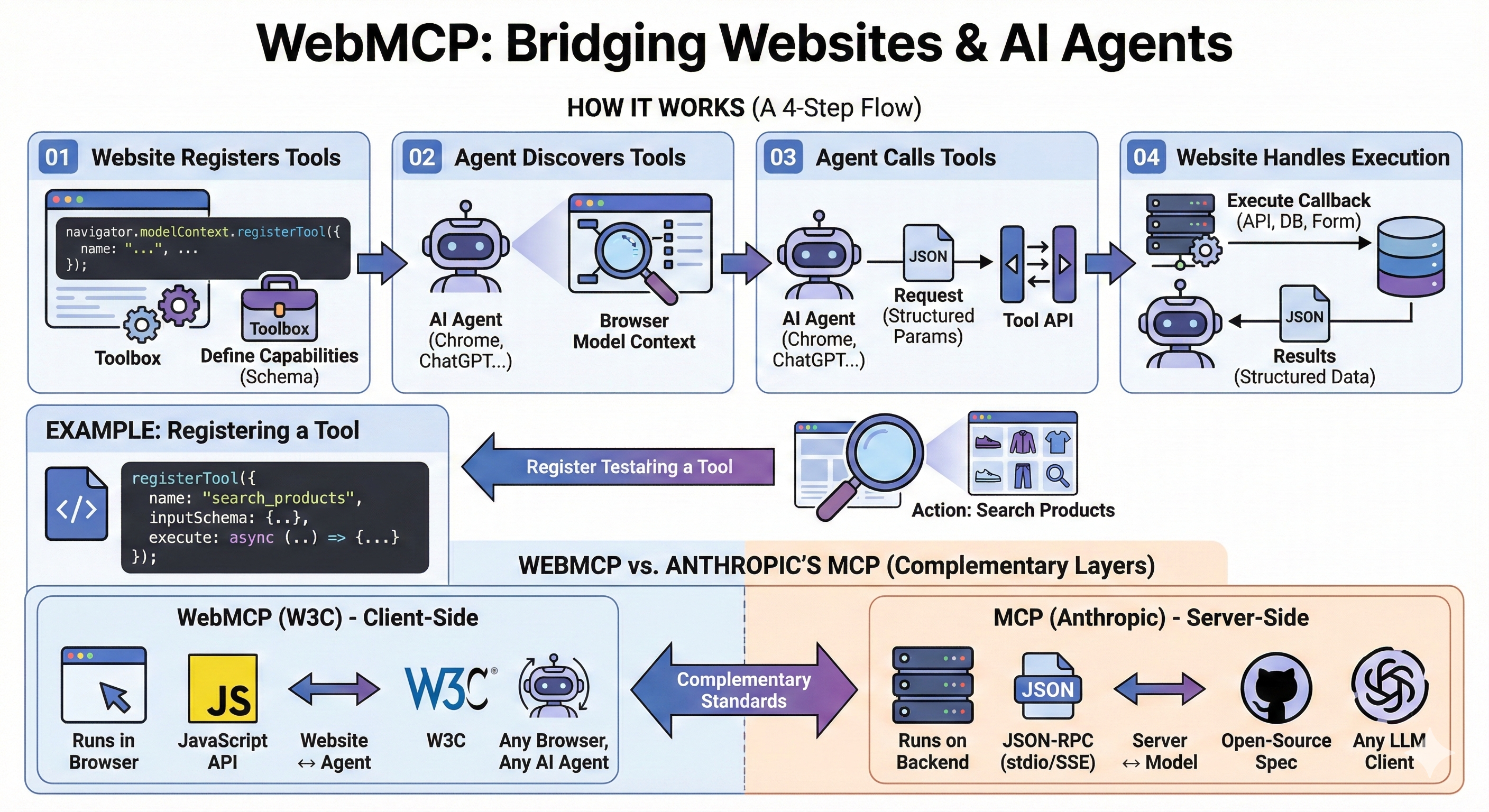
01
Website Registers Tools
Your site calls navigator.modelContext.registerTool() to declare capabilities with names, descriptions, and JSON Schema input definitions.
02
Agent Discovers Tools
When an AI agent (Chrome built-in, ChatGPT, Claude, Gemini) visits your page, it queries the browser's model context to see what tools are available.
03
Agent Calls Tools
The agent selects the right tool, provides structured parameters matching the input schema, and invokes it through the standard API.
04
Website Handles Execution
Your tool's execute callback runs, performs the action (API call, database query, form submission), and returns structured results to the agent.
You may have heard of Anthropic's Model Context Protocol. These are complementary
standards that operate at different layers -- not competitors.
WebMCP (W3C)
Client-side, runs in the browser
JavaScript API via navigator.modelContext
Website-to-agent communication
W3C community standard
Any browser, any AI agent
MCP (Anthropic)
Server-side, runs on your backend
JSON-RPC protocol over stdio/SSE
Server-to-model communication
Open-source specification
Any LLM client that supports MCP
The takeaway: A business might use MCP
to expose backend APIs to AI coding assistants and internal tools, while using WebMCP
to make their public website accessible to browser-based AI agents. Different layers,
same goal: making your systems AI-interoperable.
W3C Specification
WebMCP is being developed as a W3C Community Group deliverable with contributions from
Google Chrome and Microsoft Edge teams.
webMCP is backed by independent academic research published on arXiv. The paper by Dilshaan Perera
provides the empirical foundation for the efficiency and reliability gains that structured
client-side interaction delivers.
webMCP: Efficient AI-Native Client-Side Interaction for Agent-Ready Web Design
Dilshaan Perera — arXiv:2508.09171 — August 2025
"webMCP addresses inefficiencies in how AI agents interact with web pages by embedding
structured interaction metadata directly into web pages. Rather than processing entire
HTML documents, agents access pre-structured data, significantly improving efficiency
while maintaining high task success rates across diverse real-world scenarios including
online shopping, authentication, and content management workflows."
Key Finding
The system requires no server-side modifications, making it deployable on existing websites
without infrastructure changes. Independent WordPress testing confirmed consistent improvements
in production content management workflows.
This standard creates value at every level of the digital ecosystem.
For Consumers
AI assistants become genuinely useful for real tasks. Instead of agents that fumble
through pages and get confused by redesigns, WebMCP-enabled sites give agents reliable,
structured interfaces.
Book appointments through AI assistants
Complete purchases with verified tool calls
Get accurate answers from site-defined tools
Search catalogs and databases directly
For Businesses
WebMCP creates a new discovery and engagement channel. As AI-driven browsing grows,
sites that expose structured tools become directly accessible to agents -- meaning
more conversions from AI-assisted users and reduced support overhead.
New acquisition channel through AI agents
Controlled access -- you define what agents can do
Reduced support load from AI-handled queries
Future-proofed digital presence
For Marketing and SEO
WebMCP is the next frontier of discoverability. Just as websites optimized for Google
crawlers with structured data and sitemaps, they will need to optimize for AI agents
with registered tools and well-crafted descriptions. Early adopters gain the same
structural advantage that early SEO adopters captured.
AI-agent discoverability as a ranking signal
Competitive moat from early implementation
Tool descriptions as a new optimization surface
Brand presence in AI-generated recommendations
The SEO Parallel
In the early 2000s, businesses that understood and implemented structured data, proper
sitemaps, and crawl optimization gained an outsized advantage in organic search. WebMCP
represents the same inflection point for AI-driven discovery. The businesses that
implement structured tool interfaces now will be the ones AI agents recommend, interact
with, and send users to.
How We Help You Implement WebMCP
WebMCP integration is a core service -- not a side offering. We treat it with the
same rigor as our agentic marketing systems.
WebMCP Audit
Assess which website capabilities should be exposed as agent-callable tools.
Capabilities
Inventory existing site functionality
Identify high-value tool candidates
Evaluate security and access control needs
Prioritize implementation roadmap
Your Oversight
Approve which capabilities to expose
Define access boundaries
Review security implications
Set implementation priorities
Boundaries
Assessment scope limited to defined pages
Requires access to existing codebase
Recommendations depend on site architecture
Does not include implementation
Tool Schema Design
Define the inputSchema and execute callbacks for each tool in a way that is secure and useful to agents.
Capabilities
Design JSON Schema definitions for each tool
Write clear, agent-optimized descriptions
Define parameter validation rules
Architect response formats for structured data
Your Oversight
Approve tool naming and descriptions
Review schema definitions
Validate business logic alignment
Confirm data exposure boundaries
Boundaries
Quality depends on input from business stakeholders
Schema design is iterative based on agent testing
Requires clarity on backend API capabilities
Does not include backend API development
Implementation & Deployment
Build the navigator.modelContext integration into your existing website codebase.
Capabilities
Implement tool registration logic
Build execute callbacks with proper error handling
Integrate with existing APIs and services
Deploy with progressive enhancement
Your Oversight
Code review and approval
Staging environment testing
Production deployment decisions
Rollback criteria definition
Boundaries
Works within existing tech stack constraints
Requires functional backend APIs for tools
Browser support depends on standard adoption
Progressive enhancement ensures graceful fallback
AI Platform Testing
Validate tool discovery and execution with Chrome built-in agent, ChatGPT, Claude, and Gemini.
Capabilities
Test tool discovery across AI platforms
Validate parameter handling and edge cases
Measure response times and reliability
Document agent interaction patterns
Your Oversight
Review test results and coverage
Approve agent interaction behaviors
Define acceptable performance thresholds
Decide platform support priorities
Boundaries
Agent behavior varies across platforms
Testing limited to publicly available AI agents
Results depend on current agent capabilities
Cannot control how agents interpret tool descriptions
Ongoing Optimization
Monitor how agents interact with your tools and refine descriptions and schemas for better comprehension.
Capabilities
Track tool invocation patterns and success rates
Identify description and schema improvements
Monitor new AI platform compatibility
Adapt to specification updates
Your Oversight
Review analytics and recommendations
Approve schema and description changes
Set optimization priorities
Decide on new tool additions
Boundaries
Optimization is iterative, not one-time
Effectiveness depends on agent traffic volume
Cannot guarantee specific agent behaviors
Specification may evolve during W3C process
You Own the Implementation
Consistent with everything we build: you get the complete source code, documentation,
and training. No vendor lock-in. The WebMCP integration runs in your codebase, on
your infrastructure. Ongoing support available on a monthly retainer, no long-term commitment required.
The Trade-Off
You own the capability permanently. As agent traffic grows, your tools are already in
place. Ongoing optimization is available on a monthly retainer — cancel any time.
The businesses that implement WebMCP early will have their tool interfaces refined and
battle-tested by the time agent traffic reaches mainstream adoption. We can help you
start now.